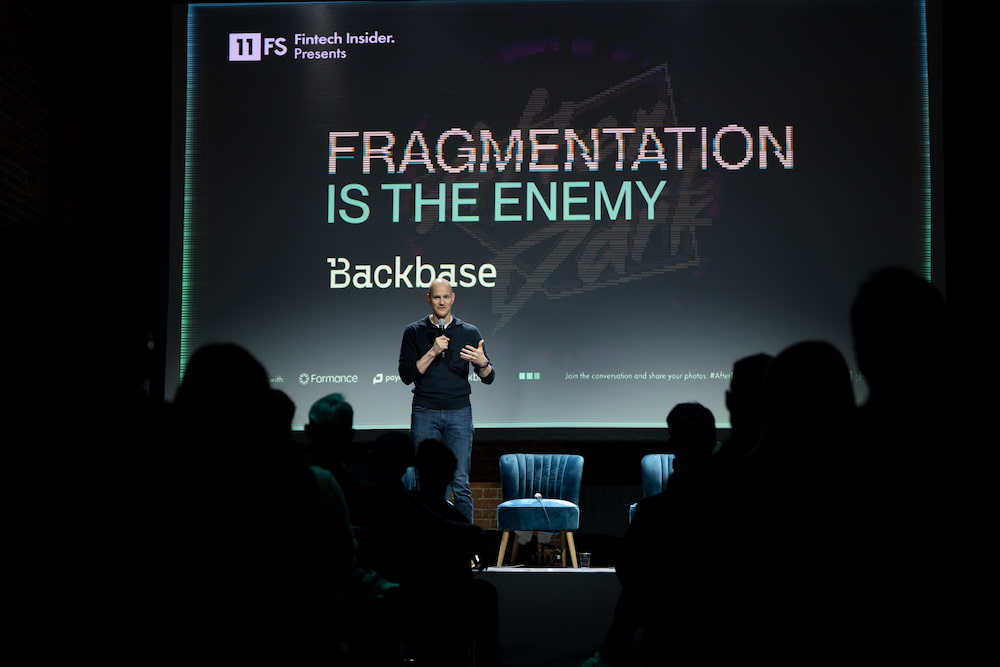
I just walked off stage at Backbase ENGAGE, where I revealed the AI-native Banking OS publicly for the first time.
In short: we’re all-in on Agentic Banking, and built the AI-native Banking OS that powers it across the Unified Frontline.
I want to unpack what we showed, because there's a lot to it, and it’s a big shift for us.
Agents are joining the workforce
Traditionally, banks were built for two actors: employees and customers. But now, for the first time in history, there is a third: AI agents - and they don’t play by the same rules. They demand a fundamentally different architecture to operate and deliver on the immense impact they bring to the table. Most banks’ architectures are not ready.

The problem: fragmentation
Banks today run on dozens of systems - core banking, CRM, payments, cards, KYC and fraud. Each system is doing its job in isolation, creating a fragmented frontline where work slips through the cracks in the messy middle.
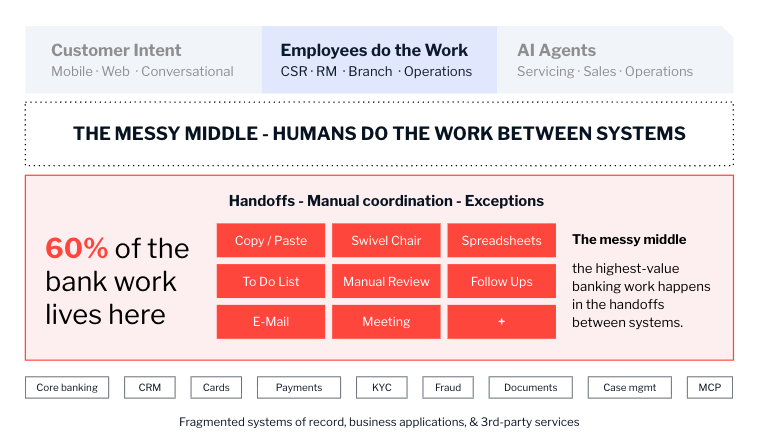
We’ve worked with hundreds of leading banks around the world and we see the same blocker everywhere. Around 60% of frontline banking work lives in that whitespace between systems. It appears in the form of handoffs, manual coordination, exceptions nobody owns, and employees having to open six screens to answer one customer question. That is where operational cost lives, and where AI hits a wall.
AI agents need unified context. They need a shared source of truth. They need authorized decision governance and clear policies before they can act. On a fragmented foundation, they get none of that. AI can't deliver reliable results and output if it doesn't have a clear view of everything that is happening in the bank.
This is something banks need to address now because agents are here. They are joining the workforce, ready to deliver, but only if the foundation beneath them is ready. An agent that doesn't know what it's authorized to do or an agent writing back to four different systems with four different versions of the truth is nothing but a recipe for disaster.
Running a Unified Frontline
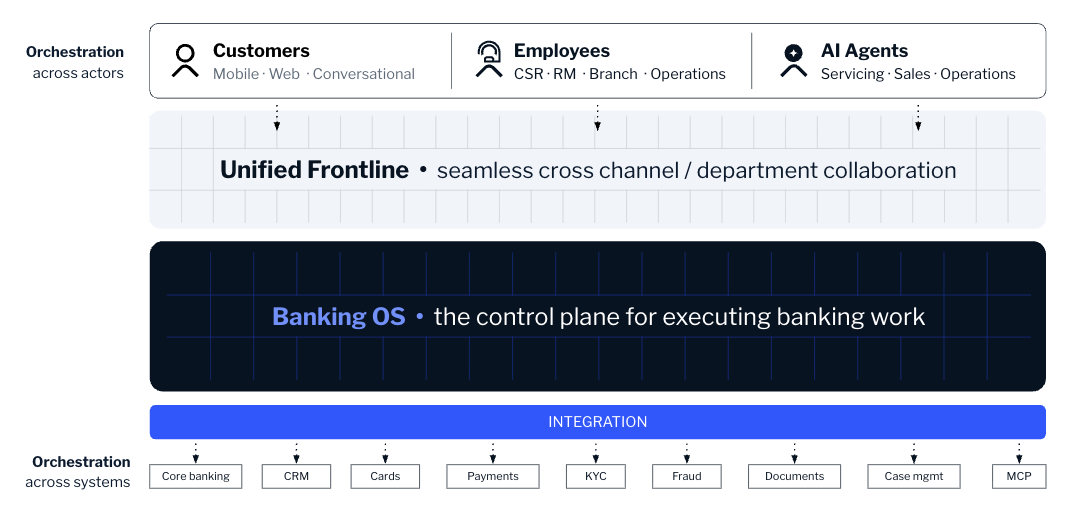
To solve the problem of fragmentation and create a foundation that's truly AI-ready, banks need to unify their entire customer-facing operation - digital channels, front office, and operations - into one operating model. This results in one shared context with one set of policies and one execution layer where customers, employees, and AI agents work together to run the bank as one.
Banks need an AI-native operating system
We built the AI-native Banking OS to be the Control Plane of the Unified Frontline. It sits above systems of record. It doesn't replace cores, CRMs, or data platforms. It coordinates the work between them - the work that currently lives in the whitespace.
- Interaction Layer: Engages. Customers, employees, and AI agents engage through apps, workspaces, voice, and natural language.
- Orchestration Layer: Executes. Runs deterministic workflows, long-running agentic work, and banking microservices across people and systems.
- Authority Layer with Sentinel: Decides. Determines whether a person, AI agent, or service may take a consequential action. Every authorized action yields a Decision Token.
- Intelligence Layer: Understands. Detects signals, uses models to reason and propose actions, and learns from outcomes.
- Operational Memory with Nexus: Remembers. Maintains a governed, current representation of the bank’s work, including customer context and case state.
- Connectivity with Grand Central: Connects. Links and synchronizes the Banking OS with cores, CRMs, payments, risk systems, data platforms, and fintech services.
This is not a set of shiny features. It’s an entirely new way of working and a new model, and the outcome is a frontline that doesn’t break under load.
We call it Elastic Operations
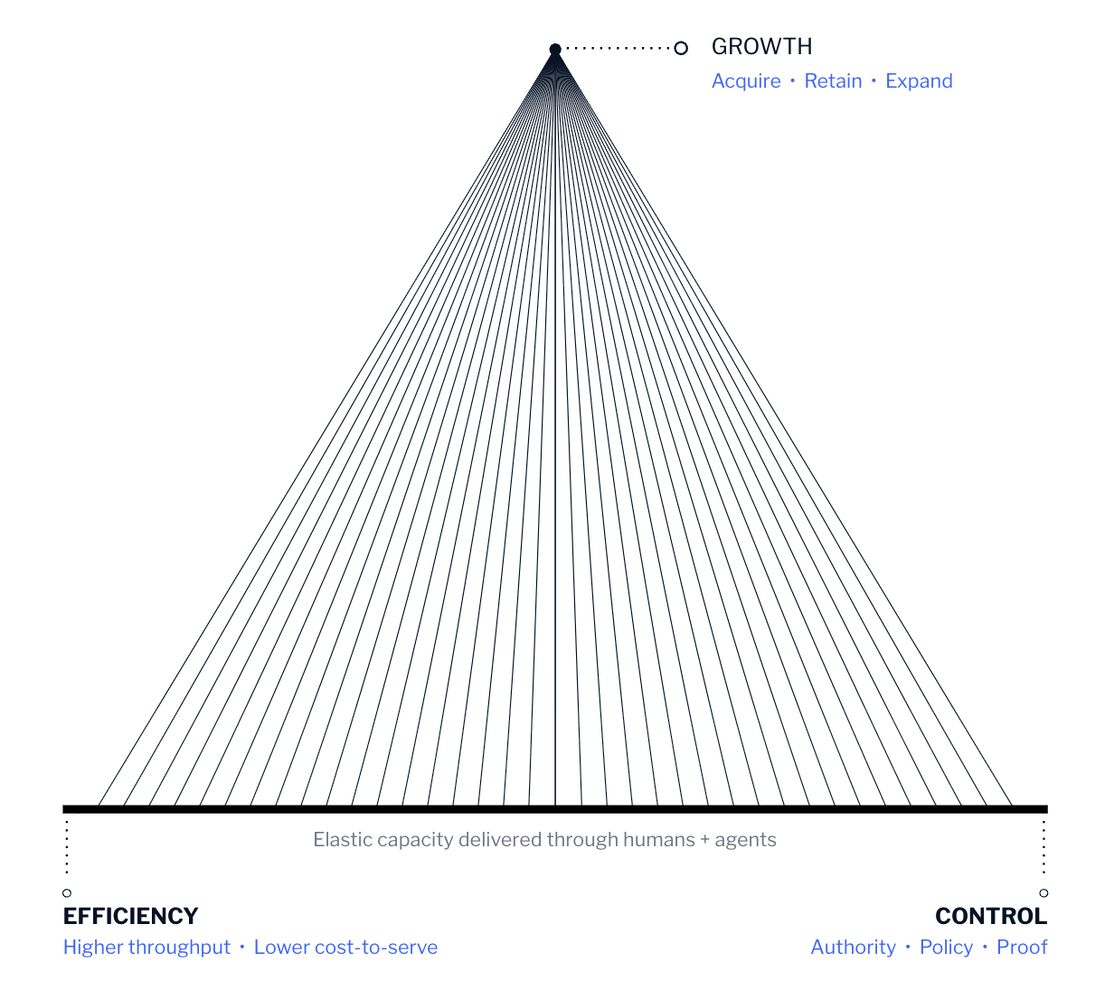
When the frontline is unified, banks can scale throughput without scaling their capacity linearly. Agents absorb routine work, while employees handle what requires human judgment. Every decision is traceable and every action is authorized.
When the frontline is unified, AI agents can work alongside employees under bank-defined authority, with human approval where policy requires it.
But it all comes down to the architecture you build on today.
Adding AI won't fix a fragmented foundation. The inevitable better model won't either.
Only the right architecture can fix it, and the architecture you build now will determine what your bank will become in the next decade.